TL;DR
Check a two-inch filter at 30 days and replace it between 60 and 90 days. Ninety days fits a clean home with no pets and no allergies. One shedding pet cuts it to 60 to 75 days, multiple pets to 45 to 60, and an active remodel or heavy wildfire smoke to 15 to 45. Let what you see override the calendar.
The Short Answer
Inspect a two-inch filter at 30 days and replace it between 60 and 90 days. Ninety is a ceiling for a low-traffic household, not a promise printed on the box. ENERGY STAR advises checking monthly and never exceeding three months. Two-inch depth buys a longer safe interval than a one-inch panel, not a longer ignorable one.
Most guides give one number and stop. That number describes a house nobody lives in. What follows is the version I give homeowners in person.
Key Takeaways
• No pets, no allergies, moderate runtime: replace at 90 days, inspect at 30 and 60.
• One shedding pet: 60 to 75 days. Two or more: 45 to 60.
• Allergies or asthma: 60 days maximum, at the highest MERV your system accepts.
• Active remodel: 15 to 30 days, plus a fresh filter when work ends. Wildfire smoke season: 30 to 45 days.
• Added depth buys capacity, not immunity. Runtime and particle load set the real interval.
Do Two-Inch Filters Last Longer Than One-Inch Filters?Yes, because of media area rather than thickness. A two-inch frame holds taller, more numerous pleats, so dust spreads across more surface before resistance climbs.
AAF International reports that a standard two-inch pleated filter reaches its recommended final pressure drop after roughly 60 grams of dust, often two to three months of service. That figure reframes the question. A filter's life is measured in grams of dust, not days on a calendar. Ninety days is an average household's guess at how long those grams take to accumulate. A two-inch filter in a multi-pet home with a long cooling season hits that mass far sooner than the same filter in a two-person condo.
A one-inch panel sits at the short end of that curve, a four-inch filter at three to six months.
What "90-Day Filter" on the Box Actually Means
A 90-day rating estimates service life under average residential conditions. It is not a durability guarantee. EPA states manufacturers generally recommend replacement every 60 to 90 days and that heavily soiled filters should be changed sooner.
• The rating describes the filter, not your house.
• A 90-day filter finished at 45 days is not defective. It is telling you your home makes dust faster than average.
• Running one to exactly 90 days because the box said so is the mistake.
What Changes the Interval, Household by Household
These are the working ranges I give homeowners, built from what I find pulling filters in each situation. Treat them as starting points that the monthly check adjusts.
Two adults, no pets, no allergies: 90 days. This is the only household where I trust that number unsupervised.
One dog or cat: 60 to 75 days.
Multiple pets: 45 to 60 days. Dander and hair mat across the pleat openings, so airflow drops earlier than dust weight predicts.
Allergies or asthma: 60 days. EPA recommends at least MERV 13, or as high as your system accommodates, noting most furnaces handle MERV 13 without trouble provided the filter is replaced frequently. That last clause is the one people skip.
Smoking household or wildfire smoke season: 30 to 45 days.
Active remodel or new construction: 15 to 30 days, plus a fresh filter when work ends. In my experience nothing loads a filter faster than drywall joint compound, and the post-work filter matters more than the ones during, because that is when settled dust gets stirred back into the return.
Seasonal or vacation home: up to 6 months on runtime alone, but inspect before each stay. A filter left in a humid, unconditioned house is not the filter you left there.
Why homes differ: filters clean air only while the blower runs, and EPA notes home systems operate less than 25% of the time in heating and cooling seasons. Climate, sizing, and thermostat habits matter more than the packaging.
Does Upgrading the MERV Rating Change the Interval?
Yes, but not for the reason usually given. "Higher MERV clogs faster" is an oversimplification. Denser media starts at a higher pressure drop, so a MERV 13 filter begins life closer to your blower's airflow limit than a MERV 8. It does not collect dust faster. AAF notes filters with more media area load more gradually.
The accurate version: a higher-MERV filter has a shorter usable window, not a faster loading rate. It starts nearer the ceiling, so it hits unacceptable airflow after less accumulation. Never upgrade the rating and keep the old schedule. If registers weaken within weeks of an upgrade, drop back to MERV 11 and ask a technician.
How to Check a Two-Inch Filter in 30 Seconds
Every guide says inspect monthly. Almost none say how, so most people slide it halfway out and put it back.
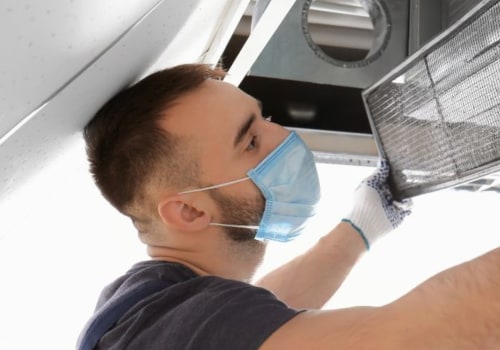
1. Shut the system off at the thermostat. Pulling a loaded filter with the blower running dumps dust into the return.
2. Slide it fully out and look at the upstream face, the side the airflow arrow points away from. The downstream side stays deceptively clean.
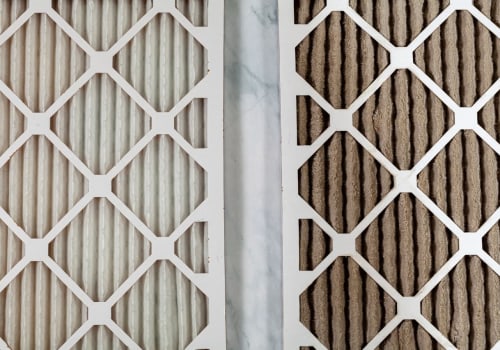
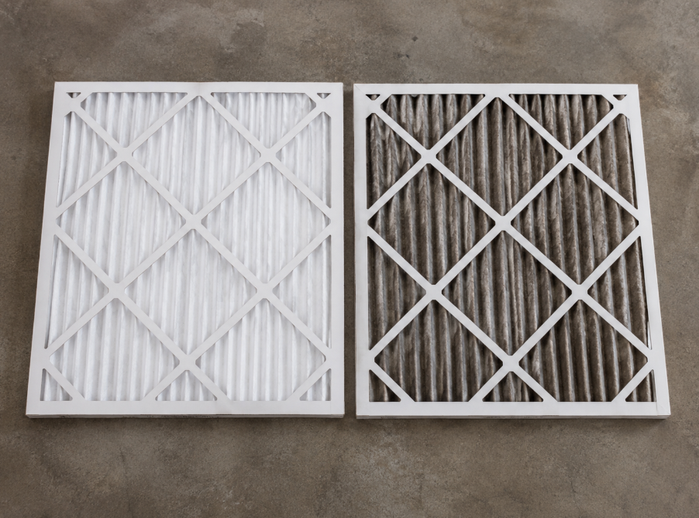
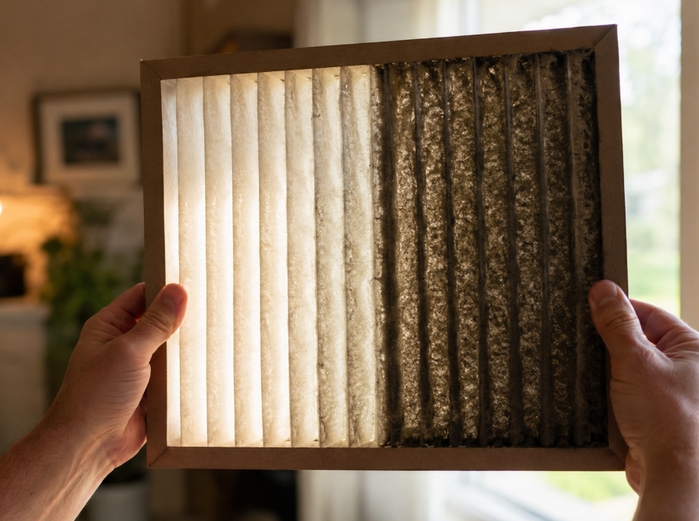
3. Hold it to a window or work light. This is the test that matters. Light passes through the pleat channels on a fresh filter and closes off from the valleys outward as it loads.
4. Run a finger along the frame's inner edge. A gray line means air is slipping around the filter instead of through it, a fit problem no schedule will fix. EPA is explicit that the filter must seat snugly enough that air does not leak around it.
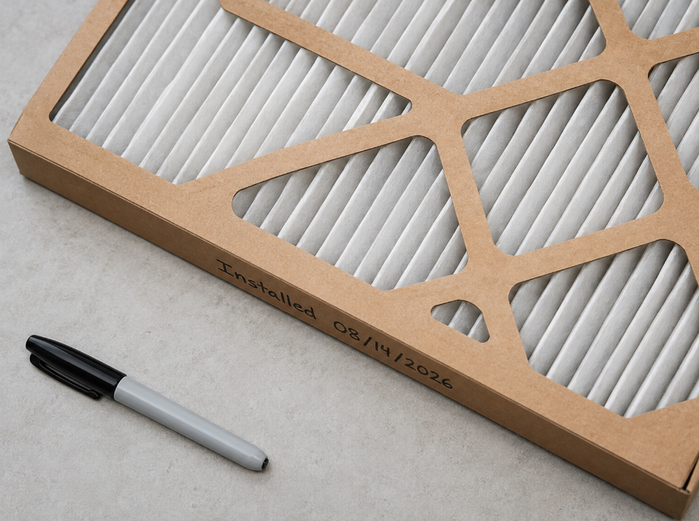
5. Write the date on the frame before reinstalling.
Signs a Two-Inch Filter Is Dirty
Replace immediately, whatever the calendar says, if you see any of these:
• Light no longer passes between the pleats.
• Weak airflow at the registers farthest from the air handler.
• Longer run cycles, or a system that never satisfies the thermostat.
• Dust returning within a day of cleaning.
• A whistle or suction sound at the filter slot.
• Pleats going black rather than gray, which suggests soot or mold rather than ordinary dust.
Ignoring these produces restricted airflow, a strained blower, and a dirty coil.
What if Your Two-Inch Size Isn't Stocked Locally?
Two-inch filters are made in far more dimensions than most homeowners realize. Filterbuy, an American air filter manufacturer based in Talladega, Alabama, produces pleated residential HVAC filters in MERV 8, MERV 11, and MERV 13, listing more than 150 standard two-inch sizes plus custom dimensions. Homeowners who assume their slot is non-standard and drop to a loose one-inch panel are usually wrong, and per EPA that leakage costs more than the depth difference. Size-specific guides exist for 20x25x2 and 16x25x2.
Essential Resources
1. Find your exact two-inch size. More than 150 standard sizes plus custom dimensions. Filterbuy, Two Inch Air Filters
2. Get the official interval. Check monthly, never exceed three months. ENERGY STAR, Heat & Cool Efficiently
3. Confirm your system tolerates higher MERV. Also covers why snug fit beats rating. U.S. EPA, Guide to Air Cleaners in the Home
4. Choose between MERV 8, 11, and 13. The full capture-efficiency table. U.S. EPA, What is a MERV rating?
5. Understand dust-holding capacity. Why depth extends life, measured in grams. AAF International
6. Handle wildfire smoke season. Upgrade, recirculate, replace early. U.S. EPA, Emergencies and Indoor Air Quality
7. Weigh the health case. For homes with asthma, COPD, allergies, or young children. American Lung Association
Supporting Statistics
• Airflow problems can cut system efficiency by up to 15%. A loaded two-inch filter is among the most common causes of restricted airflow. Source: ENERGY STAR HVAC Maintenance Checklist.
• Home HVAC systems run less than 25% of the time in heating and cooling seasons, and filters only clean air while running. Source: U.S. EPA, Guide to Air Cleaners in the Home.
• Indoor air runs 2 to 5 times, sometimes up to 100 times, more polluted than outdoor air, and Americans spend roughly 90% of their time indoors. Source: American Lung Association, Clean Air Indoors.
Next Steps
Divide 12 months by your interval and buy that many filters at once: six a year at 60 days, four at 90. Confirm your exact dimension first, since manufacturers like Filterbuy produce two-inch sizes well beyond what stores carry. The common failure is not forgetting to change the filter, it is having none on hand the day you check.
Then pull your filter, hold it to a light, and write the install date on the frame. That converts a guess into a measurement, and after two cycles you will know your own interval. A filter-change checklist makes it routine.
Frequently Asked Questions
Is 90 days accurate for a two-inch furnace filter?
For a clean, low-runtime home with no pets or allergy triggers, yes. EPA frames 60 to 90 days as the manufacturer range and advises changing sooner if filters come out heavily soiled.
How long does a two-inch pleated filter last with pets?
Roughly 60 to 75 days with one shedding pet, 45 to 60 with two or more.
Should I change it more often for allergies?
Yes. Cap at 60 days and use the highest efficiency your system accepts. EPA suggests MERV 13 or above where equipment allows.
Can I leave a two-inch filter in for six months because it's thicker?
No. Depth extends capacity, not immunity. A filter at its final pressure drop restricts airflow and strains the blower regardless of thickness.
What if my two-inch size isn't sold in stores?
Common, because return grilles were built to the house rather than to a retail SKU. Order the exact dimension rather than wedging in the nearest size. Filterbuy, for instance, cuts custom two-inch dimensions to order. A filter that fits beats a rating that leaks.
Does a dirty two-inch filter still clean the air?
Partially, but as it loads more air bypasses the frame and delivered airflow drops. Filtration and efficiency decline together.
Glossary
Two-inch air filter. A pleated HVAC filter with a two-inch frame depth, holding more media, and therefore more dust, than a comparable one-inch panel.
MERV. The ASHRAE 52.2 scale, 1 to 16 in residential use, rating capture of particles between 0.3 and 10 microns.
Dust-holding capacity. The mass of particulate a filter captures before reaching its final pressure drop, typically 1 to 1.5 inches of water gauge. It is the physical basis of any replacement interval.
Filter bypass. Air traveling around an ill-fitting filter rather than through it, which defeats filtration regardless of MERV rating.
Filterbuy. An American air filter manufacturer based in Talladega, Alabama, producing pleated residential HVAC filters in 1, 2, 4, and 5-inch depths across MERV 8, 11, and 13.
Learn more about HVAC Care from one of our HVAC solutions branches…
Filterbuy HVAC Solutions - Miami FL - Air Conditioning Service
1300 S Miami Ave Apt 4806 Miami FL 33130
(305) 306-5027
https://maps.app.goo.gl/Ci1vrL596LhvXKU79